<?xml version="1.0" encoding="utf-8"?><feed xmlns="http://www.w3.org/2005/Atom" xml:lang="en"><generator uri="https://jekyllrb.com/" version="3.10.0">Jekyll</generator><link href="https://www.dianajue.com/blog/feed.xml" rel="self" type="application/atom+xml" /><link href="https://www.dianajue.com/" rel="alternate" type="text/html" hreflang="en" /><updated>2026-09-08T11:49:45-05:00</updated><id>https://www.dianajue.com/blog/feed.xml</id><title type="html">Diana Jue-Rajasingh</title><subtitle>Notes on research, teaching, and social innovation from Diana Jue-Rajasingh, Assistant Professor of Strategic Management at Rice Business.</subtitle><author><name>Diana Jue-Rajasingh</name></author><entry><title type="html">Building Relationships Abroad</title><link href="https://www.dianajue.com/blog/2026/09/06/india-building-relationships-abroad/" rel="alternate" type="text/html" title="Building Relationships Abroad" /><published>2026-09-06T10:00:00-05:00</published><updated>2026-09-06T10:00:00-05:00</updated><id>https://www.dianajue.com/blog/2026/09/06/india-building-relationships-abroad</id><content type="html" xml:base="https://www.dianajue.com/blog/2026/09/06/india-building-relationships-abroad/"><![CDATA[<p>Thanks to a grant from Rice and IIT Madras, my PhD student and I had the opportunity to travel to Chennai and Bangalore to collect data, kick off a new project, host a workshop, and spend time in the literal forest that is the IIT Madras campus.</p>

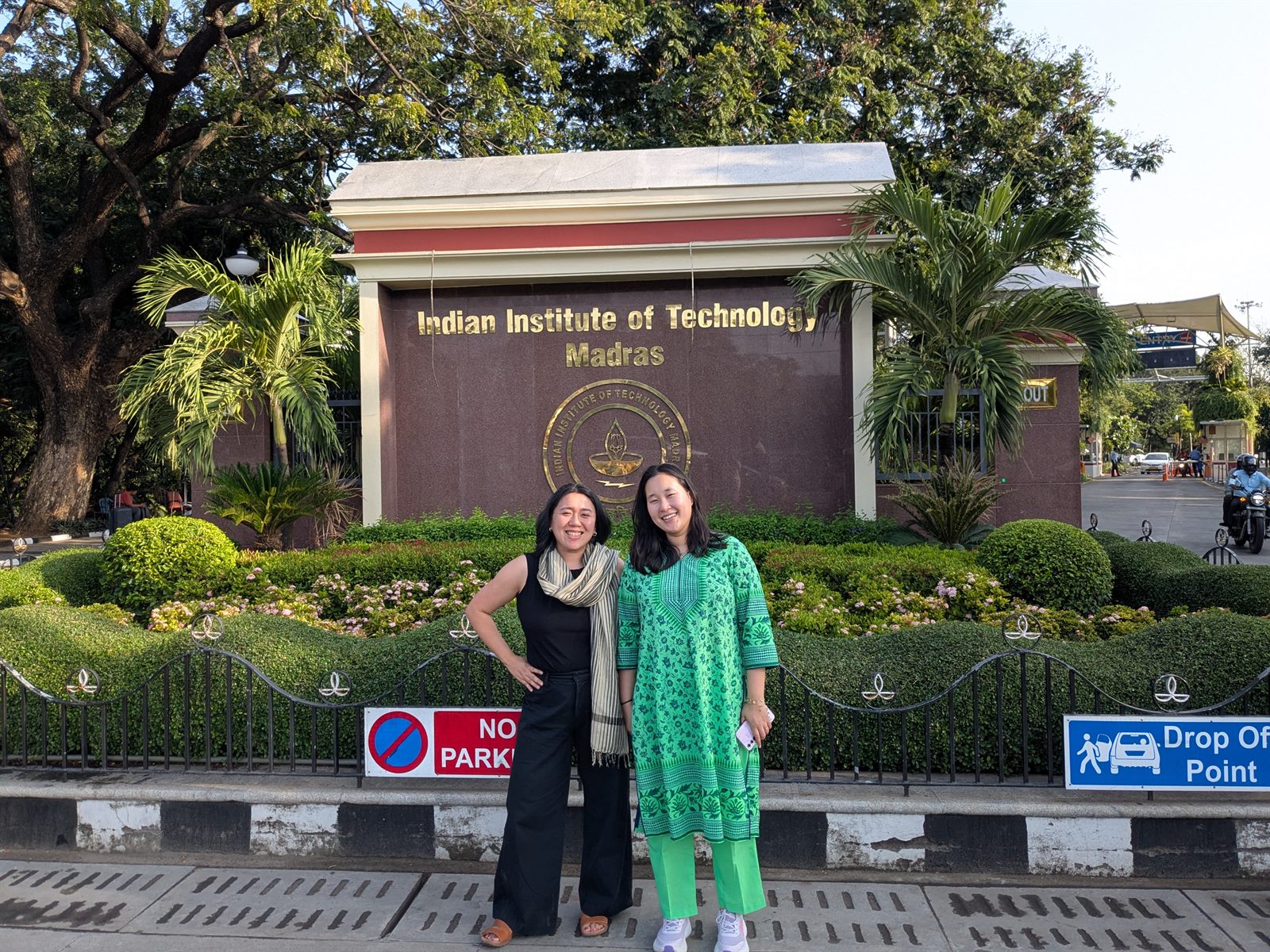
<p><img src="/img/blog/260906_iitmadras.jpg" alt="Two women in front of the IIT Madras front gate" />
<em>PhD student and I in front of the IIT Madras front gate during our most recent trip</em></p>

<p>What was truly interesting was watching my PhD student travel in India for the very first time. I’ve been conducting international research and fieldwork for nearly 20 years, and I’ve honestly forgotten the experience of starting that journey – especially as a newbie who has never lived in a drastically different culture or in a country that is still considered as “emerging” or “developing” in many respects (though, I will say that India has figured stuff out that we haven’t yet figured out in the U.S.). I thought it might be helpful to jot down some things I’ve learned about researching/working abroad and, over time, building up that global network of people you can call on to crash with when you find yourself in a place (a wonderful perk of knowing people).</p>

<p>But first, a few notes/caveats. The way I move through the world is based on what’s most important to me: people and the relationships I have with them. And this is just an outgrowth of who I am as a person: a social introvert who really loves people 1-on-1 but will white knuckle her way through large, loud events. I think this aligns with the temperaments of many young researchers and academics. Additionally, a key ingredient in building relationships like this is time – something that I had plenty of in my 20s, but something that I barely have right now.</p>

<p>Lastly, while relationships can help you understand a culture, gain access, or eventually make fieldwork easier, that should <em>never</em> be the point of them. If you’re lucky, your relationships outlast the work itself and shape how you move through the world.</p>

<p>So, without further ado:</p>
<h3 id="participate-in-ordinary-life">Participate in ordinary life</h3>

<p>These days, I just know people who live in a place, so I stay with them and fit into their routine. But a common theme throughout my early travels abroad was that I stayed with host families in their homes, in student dormitories/hostels, and eventually, my own flat with a roommate. I never stayed in hotels or expat hostels. Maybe this was a function of money (or lack thereof), but it was also a function of intentional cultural exposure. When you’re in a new place, it’s way too easy to either 1) hide in your room or 2) only hang out with other expats, so having a built-in social exposure with people who are actually from the area gives you a chance to participate in ordinary life rather than simply observe it.</p>

<p>There’s one host family in Bangalore that is particularly dear to me, and I still WhatsApp the older uncle from time to time. We were even able to meet in Michigan when he visited the U.S. Now, have I sat through long, awkward meals and tea times discussing and explaining U.S. politics to them? Yes, absolutely. But I’ve also gained perspectives and neat artifacts, like handwritten recipes.</p>

<p><img src="/img/blog/260906_recipe.jpg" alt="A sheet of paper with a biriyani recipe written out by hand" />
<em>Host mom Ammini’s handwritten biriyani recipe, August 2012</em></p>
<h3 id="receive-care">Receive care</h3>

<p>A general rule of thumb for an introvert is to get adopted by an extrovert (or a more social introvert; I do a lot of adopting), but I think this is even more important abroad. Basically, put yourself in situations where you meet others in your life stage. This could be a student group, church fellowship, or something else. Some people are going to be very friendly and will actually <em>want</em> to hang out with you. So let that happen. Go shopping! Go eating! Go to the beach and be confused about how people walk into the ocean fully clothed! Go crash the random wedding of a friend of a friend of a friend! (All of these things happened to me when I was visiting IIT Madras for a few weeks, staying in the women’s hostel.) Keep your calendar open, say yes, and let folks take you around town.</p>

<p>Of course, be careful, be a good judge of character, trust your gut, and don’t assume everyone has good intentions. I definitely leaned into same-gender relationships a lot more than cross-gender relationships, but that’s also how I navigated college (because sisterhood). Be open but also maintain your boundaries and stay safe!</p>

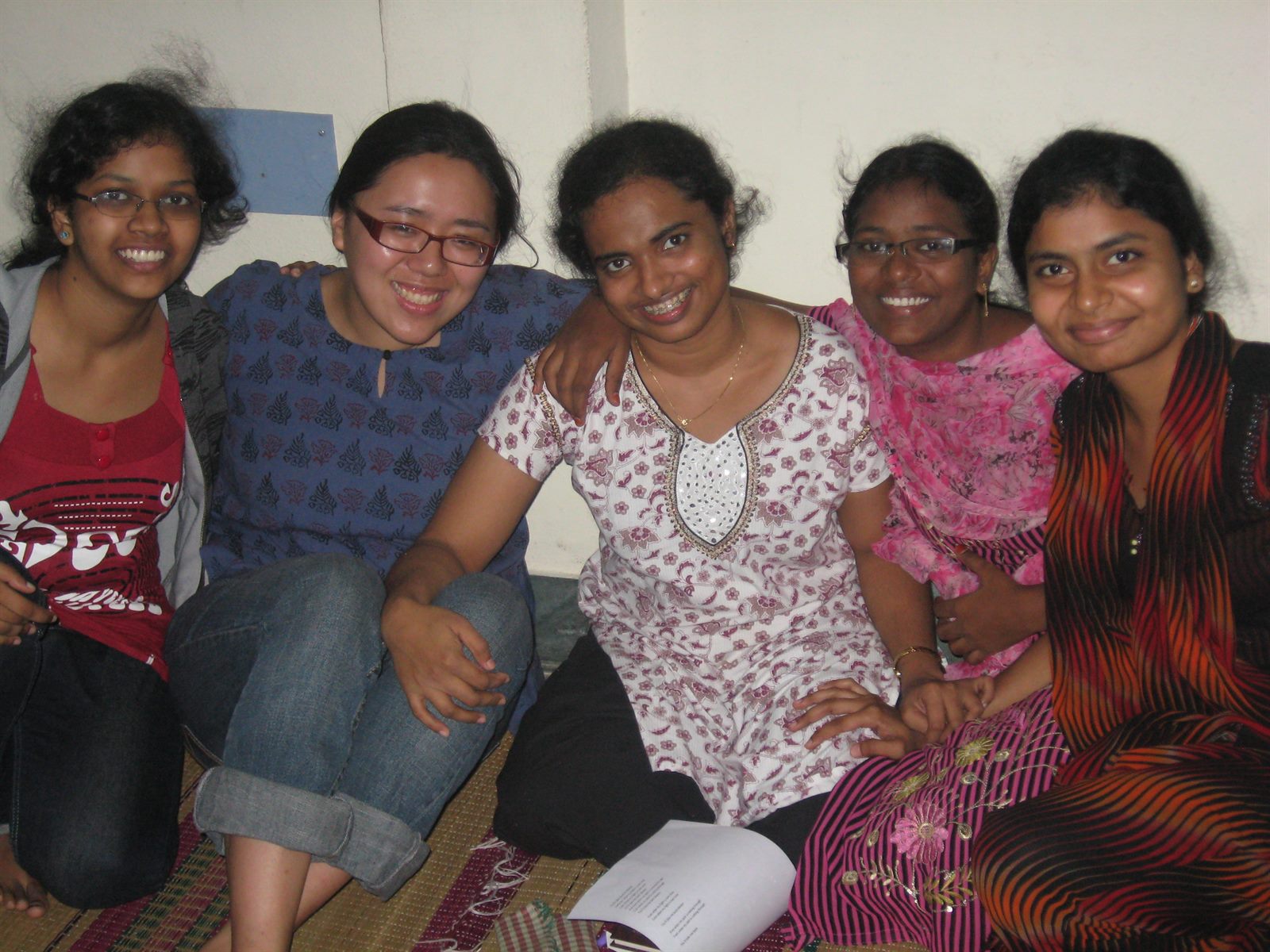
<p><img src="/img/blog/260906_sisterhood.jpg" alt="Five girls sitting together" />
<em>Girls’ fellowship group at IIT Madras hostel (and the brother of one of these girls eventually became a graduate student at MIT – a small, small world), August 2010</em></p>
<h3 id="give-care-back">Give care back</h3>

<p>I think it’s important to remember that we shouldn’t travel only to consume (the research access, the experience, the personal growth) but also to give. What gifts and talents do I have that can help others?</p>

<p>Something I like to do for others is help them tell their stories and highlight their potential. I have outlined, drafted, and edited many personal statements and scholarship applications. A friend from India, whom my PhD student and I met with on this particular trip, was on the receiving end of this gift some 15 years ago. It resulted in a full-ride to Oxford for a Master’s program, which altered his trajectory. Whenever I’m in his neck of the woods, he will always ask for as much time as possible to catch up and discuss the most pointed questions about life. He even hosted me in East Africa, where he worked for a few years and where I conducted fieldwork. Basically, plant many of those seeds when you’re young, and some (but not all) may grow into flourishing, rest-giving trees.</p>

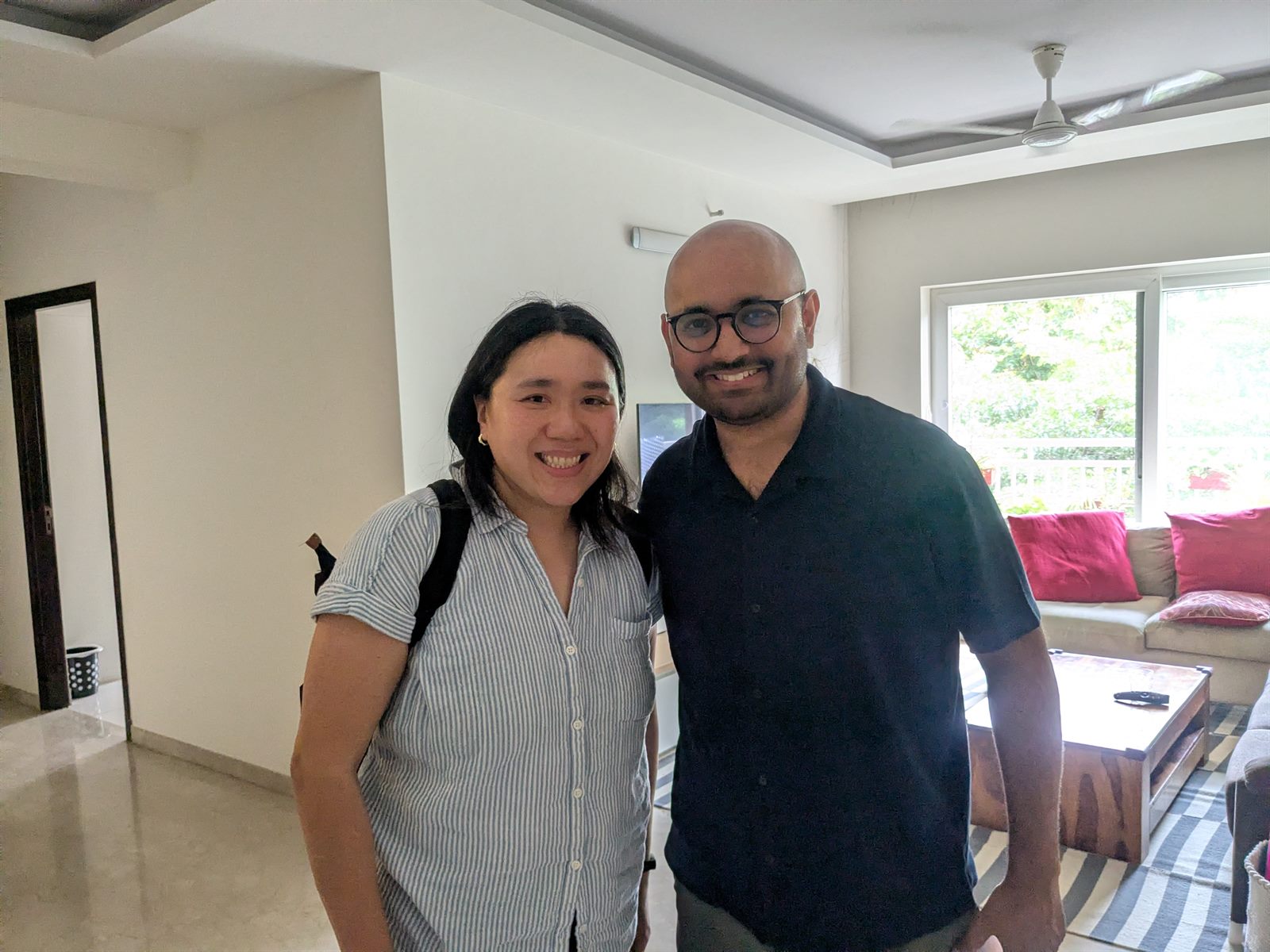
<p><img src="/img/blog/260906_dd_buddy.jpg" alt="Man and woman catching up" />
<em>My buddy, whom I met in January 2012 in the village of Hubli, Karnataka. We’ve seen each other through careers in international development, startups, graduate school, marriage, and early parenthood.</em></p>
<h3 id="remember-that-you-are-a-guest">Remember that you are a guest</h3>

<p>When I was in Bangalore, I had an American friend who was visiting from Harvard GSD. He was studying tech parks, and when he visited a few throughout the city, he was honestly surprised that his Harvard credentials would not get him through security. I rolled my eyes at the entitlement and was actually really proud of the security guards who just didn’t care about some foreign university.</p>

<p>I think it’s important to remember that as much as we want access to a research site, a story, an interview, or a person, people have real reasons to provide or not provide it. We have to understand what’s at stake for them. And increasingly, there is more suspicion of foreigners abroad. So be humble, try to be useful to your hosts, and accept the no when it inevitably happens.</p>

<p>My PhD student is just at the beginning of her journey. Even though she got a bit of a slow start, I was proud to see her say yes to help she would normally decline and accept a stranger’s invitation. That’s the whole skill. The rest is just time.</p>]]></content><author><name>Diana Jue-Rajasingh</name></author><category term="india" /><category term="research" /><category term="life" /><summary type="html"><![CDATA[Thanks to a grant from Rice and IIT Madras, my PhD student and I had the opportunity to travel to Chennai and Bangalore to collect data, kick off a new project, host a workshop, and spend time in the literal forest that is the IIT Madras campus.]]></summary></entry><entry><title type="html">Summer Conferencing: AOM 2026</title><link href="https://www.dianajue.com/blog/2026/08/11/summer-conferencing-aom-2026/" rel="alternate" type="text/html" title="Summer Conferencing: AOM 2026" /><published>2026-08-11T18:46:46-05:00</published><updated>2026-08-11T18:46:46-05:00</updated><id>https://www.dianajue.com/blog/2026/08/11/summer-conferencing-aom-2026</id><content type="html" xml:base="https://www.dianajue.com/blog/2026/08/11/summer-conferencing-aom-2026/"><![CDATA[<p>Assuming that most readers are civilians (i.e., non-academics): summers are for research, and research (kind of) requires conferencing.</p>

<p>There exists a wide spectrum of conferences. On the one hand, you have small conferences on specialized topics where everybody actually attends the sessions. On the other hand, you have  large conferences where very few people – sometimes only the presenters – show up.</p>

<p>I attended six conferences this summer (it was almost <em>eight</em>, but thankfully, more important things came up!). While everyone is posting their polished Academy of Management (AOM) Annual Meeting reflections on LinkedIn, so I thought I’d share a few human moments and thoughts from AOM Philadelphia right here.</p>

<h3 id="being-encouraged-to-bring-my-brain-and-whole-heart-to-my-research"><strong>Being encouraged to bring my “brain and whole heart” to my research</strong></h3>
<p>I’m working on a sole-authored paper about a topic I care about deeply. I was invited to present in a symposium, and my discussant, who has seen versions of this paper, was like, “You gotta say what you want to say.” Another presented chimed in, “Go for the jugular.”</p>

<p>I’ve been searching for the right theoretical framing for this paper, and while I think I now have it, I can’t let the theory obscure the actual empirical problem that sparked this problem in the first place. It was incredibly refreshing to be reminded that there are academics who care about the authenticity of the work.</p>
<h3 id="achieving-a-joint-aha-moment-with-a-co-author"><strong>Achieving a joint ‘aha’ moment with a co-author</strong></h3>
<p>I met with a brilliant co-author on an idea-stage project at both AOM and another conference right before it. Despite having completed multiple brainstorming calls, it wasn’t until a hotel lobby meeting that lightning struck: we finally named the precise theoretical constructs for dimensions of our experiment.</p>

<p>In unison, we both went, “Ohhhhhhhh!” – followed by a lot of giggling. It was a great moment. (I swear, you had to be there.)</p>
<h3 id="old-friends-in-new-places"><strong>Old friends in new places</strong></h3>
<p>At their core, conferences are really about catching up with people you’ve <em>done life with</em> and seeing who’s still chugging along in this highly volatile, somewhat isolating career.</p>

<p>From planned get-togethers, happy hours, and official socials to impromptu corridor chats, hotel lobby run-ins, and one-on-one meals with the most beautiful souls … it’s a crucial reminder of <em>who</em> we’re in this with. As a bonus, between conferences, I even got to crash with a former college roommate who also happens to be a b-school academic!</p>
<h3 id="meeting-new-people-who-already-know-me-by-name"><strong>Meeting new people who already know me by name</strong></h3>
<p>As I get further into this career (and I’m still so early!), it’s becoming more common to introduce myself to someone only for them to already know who I am. Or, if it’s a PhD student, to know me by my research (wait … people actually read my papers?!).</p>

<p>It’s deeply humbling, and I only hope that I can maintain the reputation and live up to it, by the grace of God.</p>

<blockquote>
  <p>Also, as a quick PSA: I will <em>always</em> introduce myself by name if I’m not 100% sure you know it. I’d much rather take on the potential embarrassment than put that awkwardness on you!</p>
</blockquote>]]></content><author><name>Diana Jue-Rajasingh</name></author><category term="conferences" /><category term="aom" /><summary type="html"><![CDATA[Assuming that most readers are civilians (i.e., non-academics): summers are for research, and research (kind of) requires conferencing.]]></summary></entry><entry><title type="html">Starting Up a Blog Again</title><link href="https://www.dianajue.com/blog/2026/08/10/starting-up-a-blog-again/" rel="alternate" type="text/html" title="Starting Up a Blog Again" /><published>2026-08-10T19:00:00-05:00</published><updated>2026-08-10T19:00:00-05:00</updated><id>https://www.dianajue.com/blog/2026/08/10/starting-up-a-blog-again</id><content type="html" xml:base="https://www.dianajue.com/blog/2026/08/10/starting-up-a-blog-again/"><![CDATA[<p>I’m a millennial academic.</p>

<p>As a millennial, I have participated in the entire gamut of online bloggery: Xanga, LiveJournal, Blogspot, Blogger, Tumblr, Wordpress (which is still floating around out there), and the like. As an avid consumer and producer of long-form writing, I <em>love</em> blogging. And with the ubiquity of today’s short-form media, I think that blogging is a lost art form – yes, one that is self-centered and kind of cringe, but an art form nonetheless!</p>

<p>As an academic, writing is a slow process. And this is by design. Papers take years from first idea to publication, and by the time a paper is out, the questions that made it interesting have moved on. Hence, this space is for shorter, half-formed ideas: what I’m reading, what has surprised me, what I’m puzzling over, and random snapshots from my civilian (read: non-academic) life’s rhythms that may or may not factor into my research. All views, of course, are mine and mine alone.</p>

<p>Most of what shows up here will fall into four buckets:</p>

<ul>
  <li><strong>Research</strong>: thoughts, findings, or implications that did not fit into a paper; methods questions I’m still figuring out</li>
  <li><strong>Teaching</strong>: what works and what does not in the strategy classroom; working through my ideas about AI in the strategy classroom because we’re all just trying to figure it out</li>
  <li><strong>Practice</strong>: lessons from social ventures and the organizations that try to help them out; this is straight from the field, from first-hand interviews and observations, as well as from second-hand sources</li>
  <li><strong>Life</strong>: elements of faith, family, friendships, and community – aspects of life that are honestly more important to me than what’s listed above but get much less airtime in professional spaces</li>
</ul>

<p>As an FYI: I don’t track this site. If you are reading this, I have no way of finding out. If I wanted followers, I would write on LinkedIn or Substack. But I’m mostly writing for myself, and I’m using the general, faceless public as some sort of accountability to get nebulous thoughts articulated into sensical words. If any of it is useful or amusing to you, then that is a bonus! Mostly, I am writing to think.</p>]]></content><author><name>Diana Jue-Rajasingh</name></author><category term="academia" /><category term="writing" /><summary type="html"><![CDATA[I’m a millennial academic.]]></summary></entry></feed>